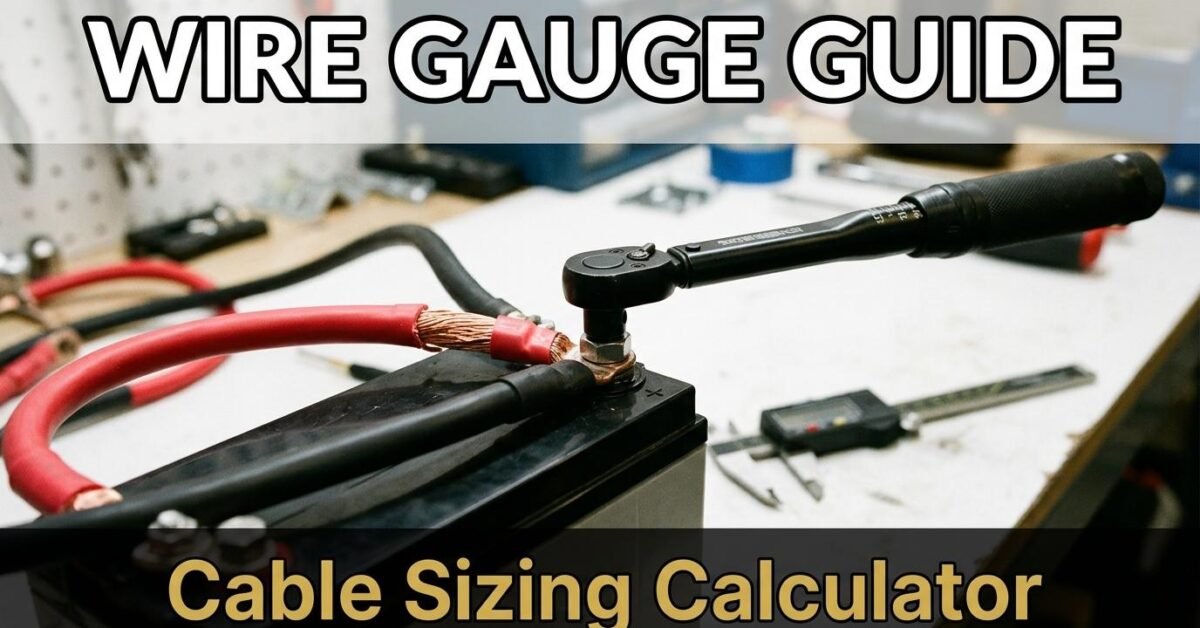
Incorrect cable sizing is the silent killer of solar system performance. A wire that is too thin for the current it carries causes voltage drop — your panels produce energy, but it is lost as heat in the cable before it reaches the battery or inverter. At 12 volts, even 2 or 3 percent voltage drop translates to significant power loss. Our Solar Wire Gauge Calculator sizes your cables in seconds — enter current, cable length, and system voltage, and get the correct AWG gauge and metric mm² with the actual voltage drop and power loss calculated.
Why Wire Gauge Matters in Solar
In a typical home powered by 230V grid electricity, cable runs are short and voltage is high, so moderate wire gauges handle the current easily with minimal loss. Solar systems are different. Battery voltages are low (12V, 24V, or 48V), and the same power requires proportionally higher current at lower voltage. A 3,000-watt load at 230V draws only 13 amps, but at 12V it draws 250 amps. That 250 amps through an undersized cable generates enormous heat and voltage drop.
The consequence is not just wasted energy. Cables running above their rated ampacity overheat, melt their insulation, and can cause fires. Voltage drop at the battery terminals means the charge controller or inverter sees a lower voltage than the panels or battery actually produce, reducing system performance and potentially triggering low-voltage shutdowns. Proper cable sizing prevents both hazards.
How the Calculator Works
Enter three values. Current in amps — this is the maximum current the cable will carry. For the solar panel to charge controller run, it is your array’s short-circuit current. For the battery to inverter run, it is the inverter’s maximum input current at the battery voltage. Cable length in meters or feet — the one-way distance from source to load. The calculator automatically doubles this for the round trip since current flows out and back. And system voltage — 12V, 24V, or 48V for DC solar circuits, or 120V/230V for AC runs.
Set your maximum acceptable voltage drop (2 to 3 percent is recommended for solar DC circuits, 3 to 5 percent is acceptable for AC branch circuits) and choose copper or aluminum conductor. The results show the recommended AWG gauge and metric mm² size, the actual voltage drop in volts and percentage, power loss in watts and percentage, and the round-trip cable length.
Voltage Drop: The Number That Matters
Voltage drop is the reduction in voltage between the source and the load caused by the cable’s resistance. Every cable has some resistance — the thinner the cable, the higher the resistance, and the more voltage is lost. The formula is: Voltage drop = Current × Cable resistance × Round-trip length. Cable resistance depends on the wire gauge (cross-sectional area) and the conductor material (copper has lower resistance than aluminum).
For solar systems, the industry standard is to keep voltage drop below 3 percent on DC circuits and below 5 percent on AC circuits. Our calculator sizes the wire to meet your chosen target, then shows the actual drop with that wire so you can verify it is within limits. If even the thickest standard gauge exceeds your target, the tool flags this — the solution is usually a higher system voltage (upgrading from 12V to 24V halves the current and quartering the voltage drop) or a shorter cable run.
AWG vs Metric: The Reference Table
The calculator displays results in both AWG (American Wire Gauge, used in the US and many international solar datasheets) and metric mm² (used in the UK, EU, Australia, and Asia). A built-in reference table shows common sizes from 18 AWG (0.82 mm², for small signal wiring) through 4/0 AWG (107 mm², for heavy inverter feeds), with the maximum ampacity for each size in copper at 60 degrees Celsius per NEC standards.
Common solar cable sizing examples: a small 12V system with 10 amps over 5 meters one-way needs 10 AWG (5.3 mm²). A mid-size 24V system with 40 amps over 8 meters needs 4 AWG (21.2 mm²). A large 48V system with 80 amps over 15 meters needs 2/0 AWG (67.4 mm²). These are the results our calculator produces — verified against NEC ampacity tables and standard voltage drop formulas.
Copper vs Aluminum
Copper is the standard for solar wiring. It has lower resistance per unit length, is easier to terminate, and handles repeated thermal cycling better. Aluminum is cheaper per meter but has about 61 percent higher resistance, meaning you need a larger gauge to carry the same current with the same voltage drop. The calculator includes an aluminum option — it automatically adjusts the resistance values and recommends the appropriately larger gauge. For most residential solar installations, copper is worth the premium. Aluminum is sometimes used for long AC runs or utility-scale installations where the cost savings on large cable quantities justify the larger gauge.
From Wire Sizing to Complete System
Cable sizing is one piece of the overall system design. The current your cables must carry depends on your panel array size (sized in our Solar System Calculator), your battery bank voltage (sized in the battery bank sizing guide), and your inverter current draw (covered in the inverter sizing guide). This wire gauge calculator is the tool you reach for after the major components are sized — it ensures the connections between them are safe, efficient, and code-compliant.
Size Your Cables Now
Our Solar Wire Gauge Calculator gives you the correct cable size for any solar or electrical run in seconds. Enter current, length, and voltage — get AWG and mm² with voltage drop and power loss calculated. Supports both copper and aluminum, both meters and feet, and DC and AC voltages. No formulas to remember, no tables to cross-reference.
Open the Wire Gauge Calculator →
⚡ Free Solar Sizing Cheat Sheet
Get our one-page guide to sizing panels, batteries and inverters — plus weekly solar tips. No spam, unsubscribe anytime.
By subscribing you agree to our privacy policy. We'll email your guide and occasional solar tips — never spam.